
Measuring Fire Injury with Lidar: New Research and podcast interview on Fire Ecology Chats
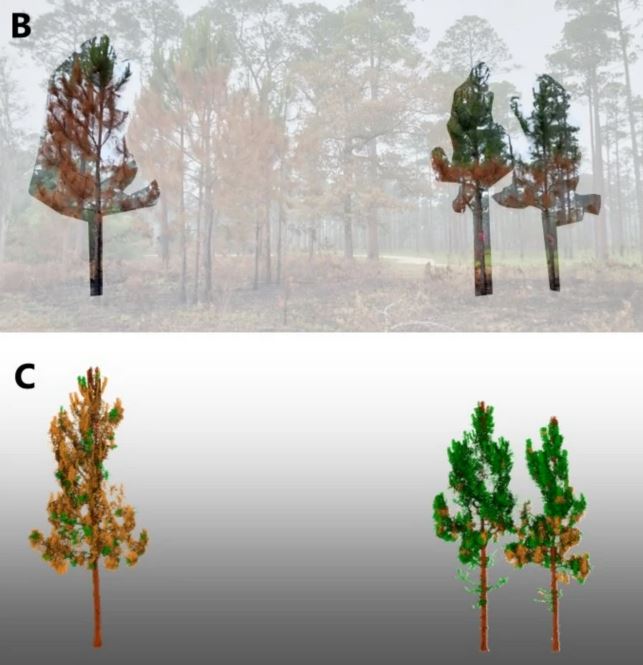
We joined a recent episode of Fire Ecology Chats, to discuss our lab’s new research using terrestrial lidar to measure fire-caused crown scorch in longleaf pine. By linking lidar return intensity to scorch severity, this approach offers a faster, more objective alternative to traditional ocular estimates—scaling fire effects measurements from individual trees to entire stands. The conversation explores implications for fire ecology, forest monitoring, and operational fire effects research.
New Study: Terrestrial lidar provides accurate and objective measures of crown scorch

A new study from our lab shows that terrestrial LiDAR scanning (TLS) can measure crown scorch in longleaf pine with unprecedented speed and objectivity. TLS provides high-resolution, quantitative estimates of fire-caused crown damage—at least 20× faster than traditional ocular methods. The CrownScorchTLS R package makes these tools accessible for researchers and land managers, enabling more precise, mechanistic studies of fire impacts on forests.